
Big idea: More than half of your response should show what you did—not just what happened to you. This guide gives you a tight, five-step structure, two short model paragraphs, and a line-edit checklist to keep your tone proactive and growth-focused.
What Admissions Readers Actually Want
Agency: Evidence you took specific steps (not just endured circumstances).
- Specificity: Concrete actions, timelines, and outcomes beat vague descriptions.
- Reflection: What you learned, how you grew, and how you now help others.
- Academic clarity: If academics were affected, explain briefly and show recovery or mitigation.
Common Pitfalls (and Easy Fixes)
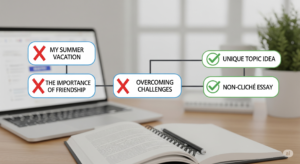
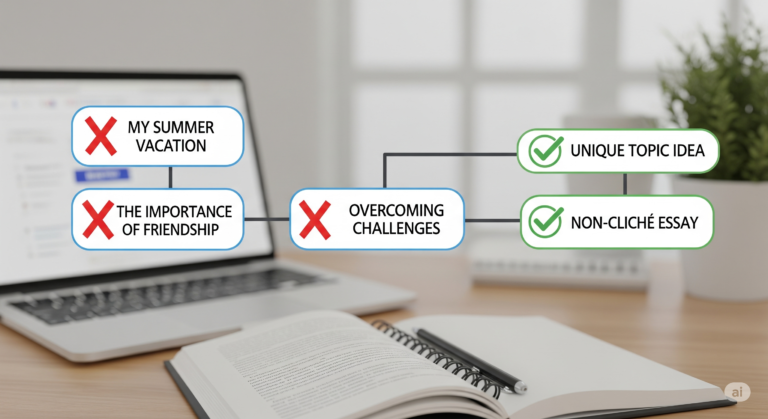
- Low-stakes “challenge”: If it wasn’t sustained or truly demanding, pick another topic (or reframe with higher stakes and clearer actions).
- All problem, no response: Shift at least 60–70% of the essay to your actions and outcomes.
- Excuse tone: Replace cause-only sentences with response sentences (“So I… set up… tracked… asked…”).
- Generic language: Swap “worked hard” for micro-details (logs, routines, metrics, deadlines).
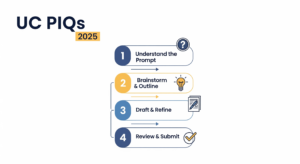
The 5-Step Framework (with Fill-in Templates)
Keep each step tight. Aim for ~30–60 words per step (you’ll likely need to combine steps to fit UC word limits).
Step 1 — The Hand I Was Dealt (Context)
Purpose: Define the challenge quickly and objectively. Avoid dramatization.
Template:
[In Month/Year], [challenge] changed [school/home/health/finances] by [specific impact].
I initially [emotion/constraint], especially when [concrete complication].
Step 2 — Early Struggle (Honest but brief)
One or two sentences that acknowledge difficulty—then pivot to action.
Template:
At first, I [misstep/limitation]. Grades in [courses] slipped to [metric], and my schedule broke down.
Step 3 — Acceptance & Plan (Turning point)
Describe the moment/realization that led to a plan. Name tools and supports.
Template:
I mapped the problem: [constraint A], [constraint B]. I built a plan using [tool/system/tutor/coach/community].
I set [2–3 measurable routines] to stabilize my week.
Step 4 — Proactive Execution (Your actions, in detail)
Show routines, systems, and iteration. Use numbers/time blocks when possible.
Template:
I implemented [routine], [schedule], and [accountability method]. Each week I [measured X], adjusted [Y],
and asked [teacher/mentor] for feedback on [Z]. By [date], [metric] improved from [A] to [B].
Step 5 — Beyond Me (Helping others / sustained change)
Shift from self-management to community impact or durable systems.
Template:
After stabilizing, I documented my system and shared it with [group/person]. I now [mentor/run workshop/lead resource],
so others facing [similar challenge] can [result].
Addressing Academic Impact Without Excuses
Answer the academic part directly—briefly—and then show the trajectory.
- Be specific: “My grade in Chemistry fell from B to C during [month–month] as I adjusted to [constraint].”
- Show response: “I began weekly office hours and a spaced-repetition routine.”
- Show trend: “By the final, my unit test average rose from 76% to 90%.”
- Keep it short: 2–4 sentences max; save word count for your actions.
Two Mini Examples (100–130 words each)
Example A — Family Caregiving & Time Systems
When my mom began night shifts last winter, childcare for my younger brother became my responsibility. I struggled to keep pace: my Algebra grade slipped to a C, and I missed two lab make-ups. I mapped the week—non-negotiables first (bus, meals, care), then study blocks—and built a 7–9 p.m. “quiet window” using a neighbor’s help three nights a week. I logged assignments on a whiteboard, pre-wrote lunch plans on Sundays, and met my Algebra teacher Fridays at lunch. By March, my quiz average rose from 72% to 89%, and labs were on time. I turned the whiteboard into a checklist my brother can use; now two other families in our building use the template I shared to coordinate sibling care during shift changes.
Example B — Health Setback & Gradual Return
After a concussion in September, screen time and noise triggered headaches, and I fell behind in APUSH and Pre-Calc. My first try—late-night cramming—made symptoms worse. With the counselor, I created 25-minute “paper-first” study blocks, moved tests to mornings, and used colored overlays for notes. I met teachers weekly to plan make-ups and tracked progress in a shared spreadsheet. By November, headaches shortened, my recall improved, and my Pre-Calc test scores moved from 68% to 92%. I compiled the accommodations into a one-page guide that my counselor now shares with students returning from injuries; I also lead short check-ins for two classmates who needed the same pacing reset I did.
Line-Edit Checklist Before You Submit
- – Does at least 60–70% of the essay describe actions you took?
- – Are there concrete details (routines, tools, time blocks, numbers)?
- – Is the academic impact handled in 2–4 clear sentences with a recovery trend?
- – Do you show one way your solution now helps others (even on a small scale)?
- – Have you cut vague phrases like “worked hard,” “pushed through,” “it was tough”?
- – Word count within UC limits; voice is steady, respectful, and specific.
FAQs
How do I know if my challenge is “significant” enough?
Can I mention mental health?
What if my grades never fully rebounded?
How many statistics should I include?
Pro tip: Draft your UC Prompt 5 in five short paragraphs that follow the steps above, then compress to fit the word limit while keeping at least one metric and one community-oriented sentence.
If you’d like structured feedback, share your draft with a mentor, teacher, or counselor who can check for agency, specificity, and tone.